General Configurations
Go to Configurations > General to access various configuration options, including data retention policy, continuous assessment settings, and miscellaneous settings such as the default landing page, sensors and sensor profiles, and integrations.
Data Retention Policy
Customize the data retention policy for sensors, containers, events, and registry schedules. This data is purged as per the defined policy. The data retention policy specifically removes data from Qualys Enterprise TruRisk™ Platform when the specified time period over.
Why are we implementing this data retention policy?
As we standardize data retention policies across Qualys Enterprise TruRisk™ Platform, we are updating the policies for various Container Security assets. Having uniform data retention policies ensures the latest data is always available, increases data relevancy while optimizing overall system performance.
To access the data retention policy options, your role must have the CS Data Retention Policy Permissions assigned.
If you do not turn on the Data Retention Policy toggle, the default retention policy of 13 months is applied.
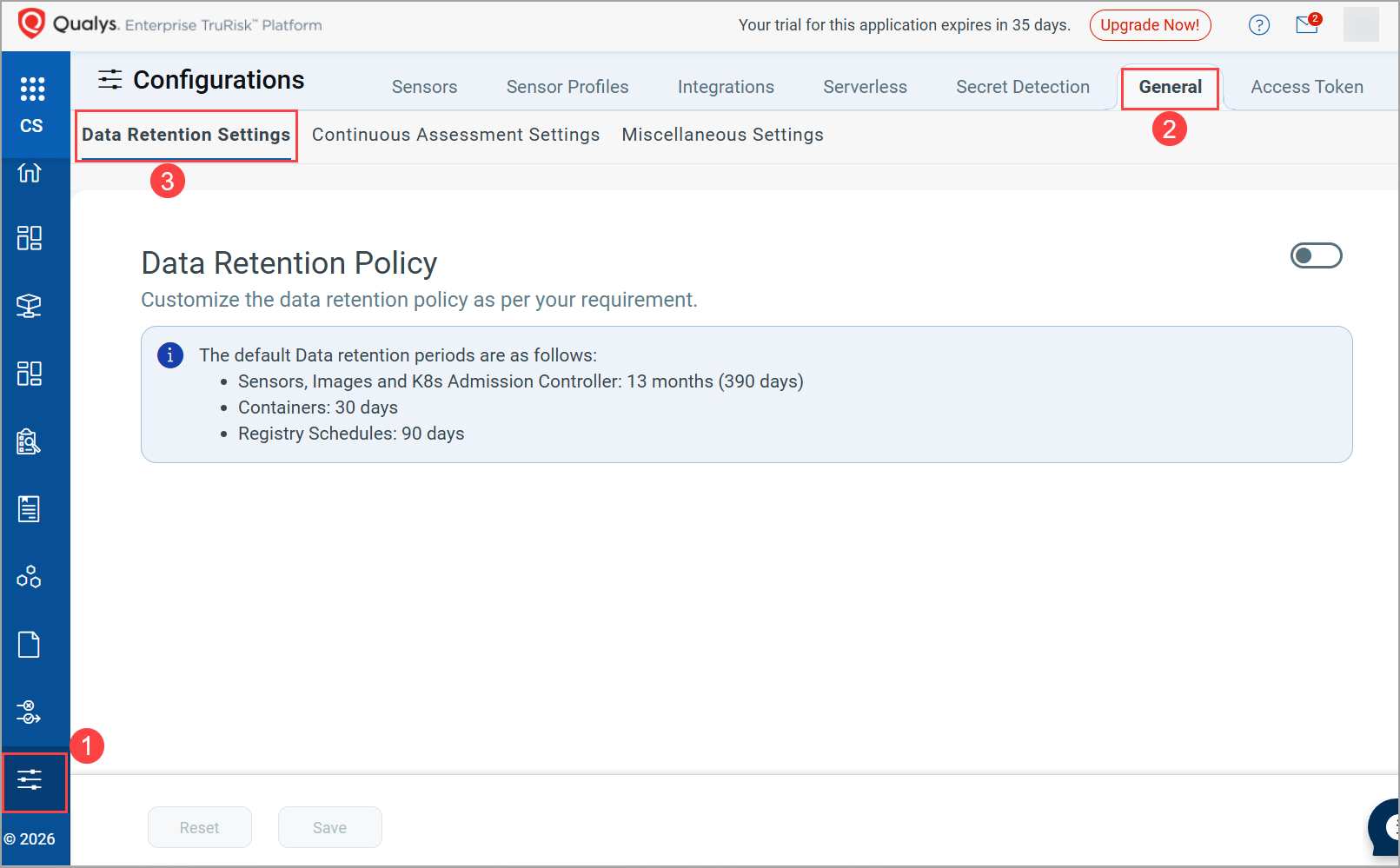
You can customize the following options:
-
Sensors: Delete the data of sensors that are in the Unknown state for more than a certain time period.
This configuration does not apply to the sensors in the AWS Fargate environment. The data retention policy for them is set to 60 days by default.
Also refer to Default retention period of assets.
-
Images: Delete the record of images that are not scanned for a certain time period.
The images that have containers associated with them are not deleted.
-
Containers: Delete the data of containers that are in the following states for a certain time period:
-
Deleted
-
Unknown
-
Stopped
-
Paused
You can also enable the Delete the container on delete event from sensor option. When enabled, containers are removed immediately from the CS inventory when a delete event is received from the sensor, instead of transitioning to the Deleted state and waiting for the retention cycle. This is useful for environments with ephemeral containers that start and stop frequently.
-
K8s Admission Controller: Delete data from Kubernetes admission controllers with an 'Unknown' status for the selected period.
-
Registry Schedules: Delete Registry Schedules with status Finished, Canceled, or Failed from the selected period.
What are the default Data Retention values for CS assets?
Data retention periods are configured with the default values shown in the table below.
Use the API to export the data before it is deleted.
|
Data Type
|
|
Retention Values (in days)
|
| Images |
Allowed range: 7 to 365
Default: 390 (13 months) |
| K8S Admission Controller |
| Sensors |
Sensors in AWS Fargate |
Allowed range: 7 to 365
Default: 60 |
| Sensor in Unknown state |
Allowed range: 7 to 365
Default: 7 |
| Containers |
Allowed range: 7 to 30
Default: 30 |
| Serverless Functions |
| Registry Schedules |
Allowed range: 7 to 90
Default: 90 |
Continuous Assessment Settings for Images
Continuous Assessment refers to the automatic and continuous scanning of container images to identify vulnerabilities, misconfigurations, and compliance issues. Continuous Assessment Settings are applicable only to the images.
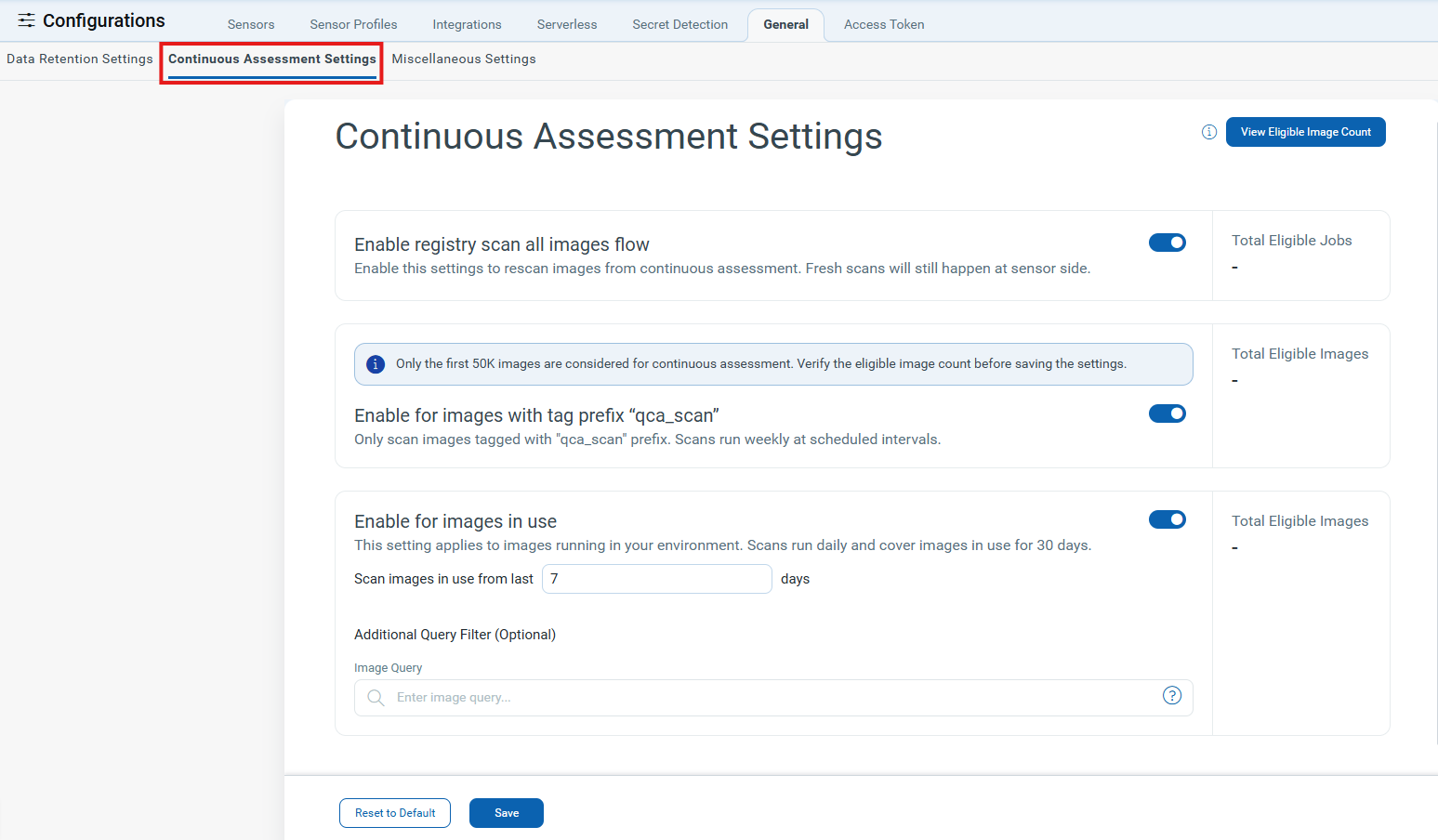
Container Security considers the following images for continuous assessment.
- Registry Images: Registry images that carry Automatic scan jobs with the Force Rescan (Select All Images) option are considered for Continuous Assessment. Previously scanned Registry images whose snapshots are available in the Qualys database are only considered for continuous assessment. New registry images carrying the Force Rescan option are scanned by the Qualys Registry Sensor.
Continuous Assessment Frequency - As per the Registry Scan job schedule
- Images with a special tag: You can mark an image for continuous assessment using a special tag prefix - 'qca_scan'.
Continuous Assessment Frequency - Weekly at scheduled intervals (Default)
- Images In Use: The Continuous Assessment considers all active images or images marked as 'Images in Use'.
Continuous Assessment Frequency - By default, the Continuous Assessment of 'Images In Use' is triggered after 24 hours.
Continuous Assessment is applicable only to the images that are,
- available in Qualys Enterprise TruRisk™ Platform.
- scanned 30 days before the current date.
Miscellaneous Settings
The miscellaneous settings cover your default product landing page, asset landing page and User scope settings.
Default Product Landing Page Setup
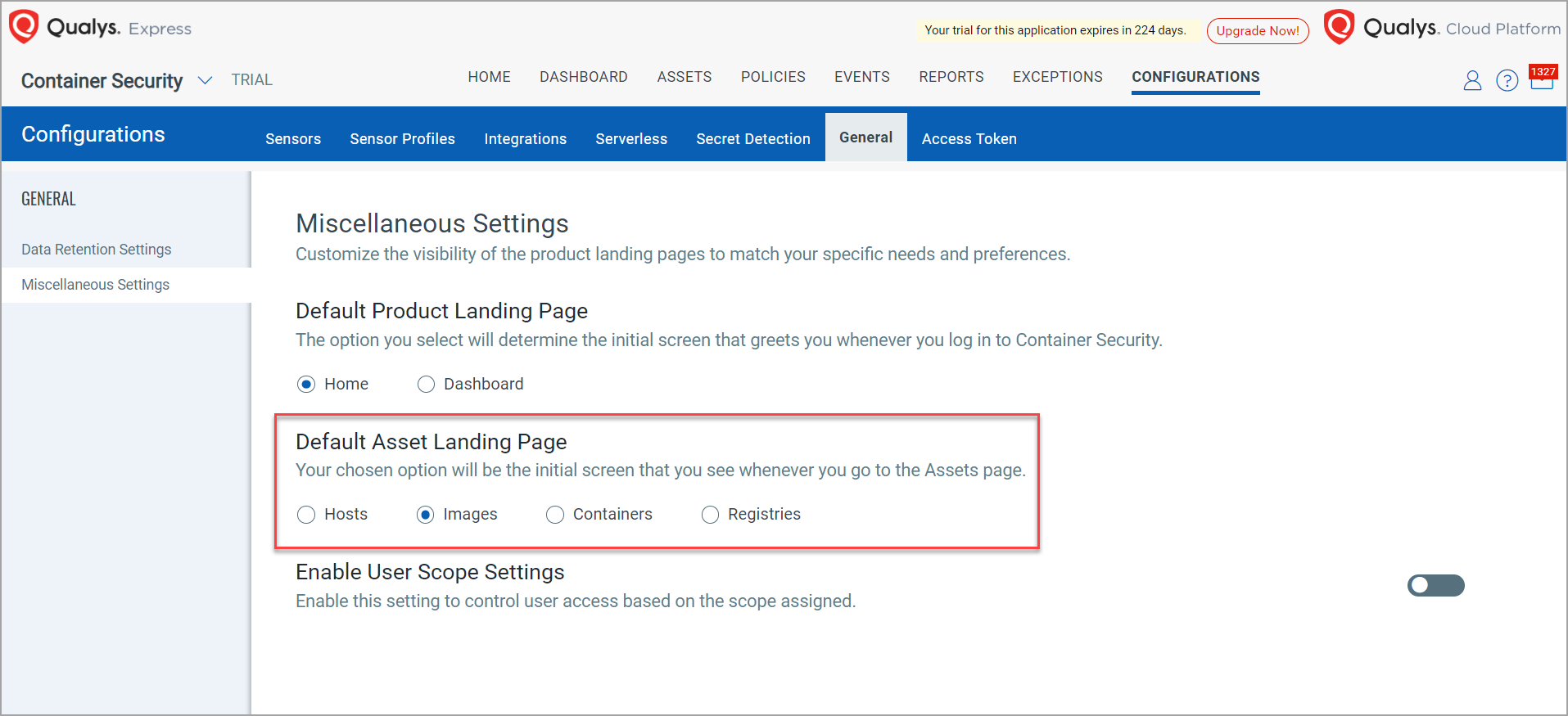
Select a default landing page for Container Security. This page appears as the first screen every time you log in to Container Security. You can choose either the HOME or DASHBOARD page as your default landing page.
Default Asset Landing Page Setup
By default, Images is considered as the default screen when you click on Assets.
You can change this setting and make either Hosts, or Container, or Registries to be your default screen for your Assets page.
Enable User Scope Settings
This option is available only to Admins. Admin can enable user scope settings with the help of this to restrict sub-users access to certain assets. They can achieve this control using a set of tags. Sub-users can only see the assets which are in their scope. Any asset which is beyond their scope will not be visible to them. These assets include images and containers. To know more, refer to the Users and Permissions section.
FAQ
Q Will I be able to access the data once the retention period has elapsed?
A No, once the data is purged as per the retention policies, the data cannot be restored. If you have any questions regarding the data retention policy for Container Security, please reach out to Qualys support.