Technology Debt Report
Technology debt (also known as tech debt) refers to the accumulated risk and cost associated with outdated, unsupported, or end-of-life technologies in your IT environment. When hardware or software reaches its End-of-Life (EOL) or End-of-Support (EOS) date, the vendor no longer provides security patches, bug fixes, or technical support. This creates a growing security gap, as newly discovered vulnerabilities in these products will remain unpatched, leaving your organization exposed to potential exploits and compliance violations.
The Technology Debt Report in CSAM is an executive-ready PDF report that helps you identify outdated hardware and software across your asset inventory. It highlights End-of-Life (EOL) and End-of-Support (EOS) products, calculates risk scores based on their EOL/EOS status and historical vulnerabilities, and provides insights to help you prioritize remediation.
The report is available from a CSAM (Trial and Full) subscription and helps security teams and leadership understand the scope of outdated technologies, assess the associated risk posture, and make informed decisions about upgrade planning and resource allocation.
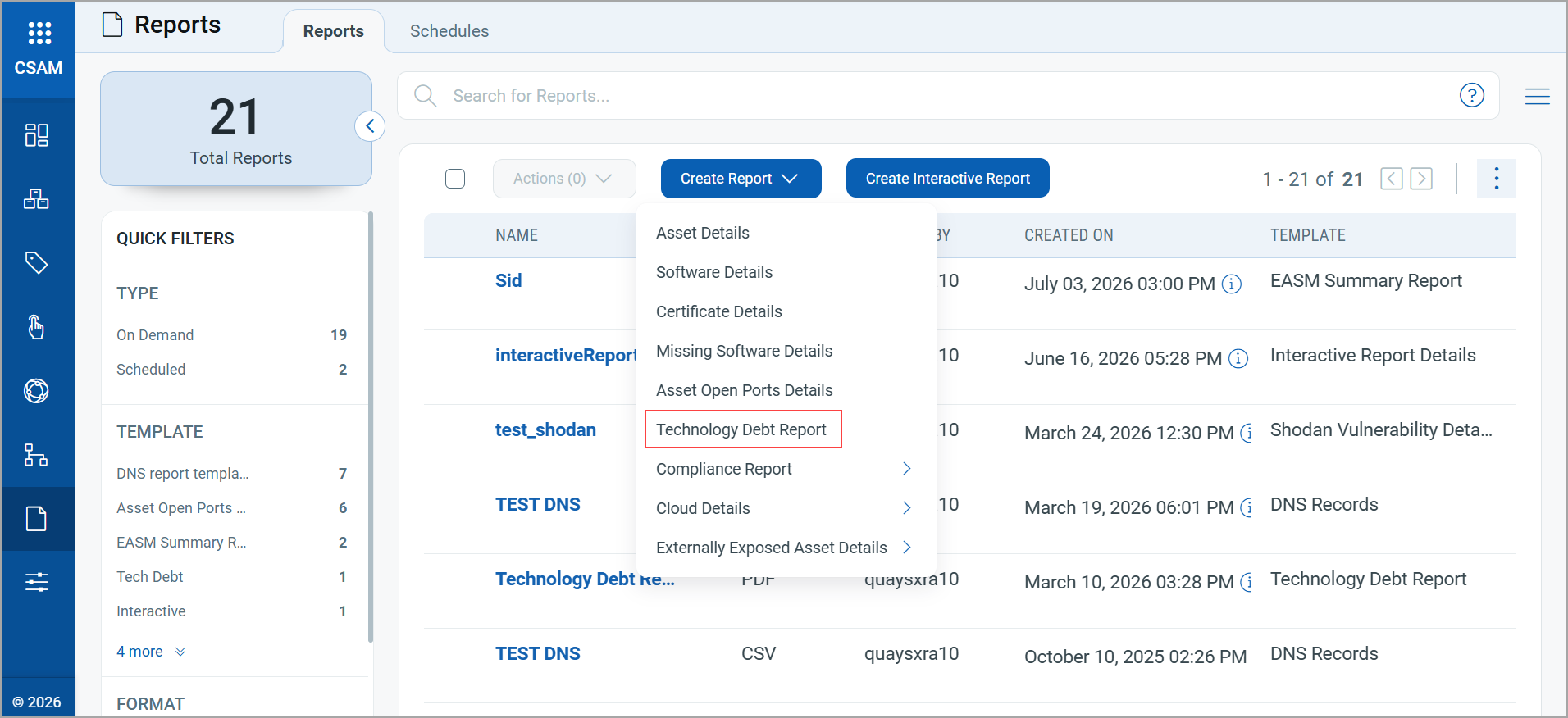
To create a Technology Debt Report, navigate to Reports > Create Report > Technology Debt Report.
Features and Benefits
The Technology Debt Report enables you to:
- Communicate a transparent and actionable assessment of your enterprise's Tech Debt.
- Highlight risks associated with End-of-Life (EoL) and End-of-Support (EoS) hardware and software with an executive-ready report.
- Prioritize and proactively plan upgrades for highly vulnerable End-of-Support software that will not have security patches.
- Foster a proactive risk management culture and informed decision-making to protect your assets and align your security efforts with your overarching business goals.
Who can generate this report?
CSAM users can generate and download the Tech Debt report, and VMDR customers with CSAM can also generate it.
Important to Know!
- You need a super user role within your Qualys subscription with report generation access to generate the Tech Debt report. Contact your Technical Account Manager (TAM) or Qualys Support for assistance if you don't see the Generate option.
- The automated 'Technology Debt Report' can be generated only once per user for your subscription. If multiple users on your subscription have access to report generation, each can generate this report once.
How is QDS for Tech Debt EOL/EOS Calculated
The Qualys Detection Score (QDS) score is calculated every three months as a product moves closer to or further past its End-of-Life (EOL) or End-of-Support (EOS) date. Due to this changes are reflected every three months.
The overall score is calculated using the following formula:
Score = (0.6 x Aggregate QVS Score) + (0.4 x EOL/EOS Timeframe Score)
This means that 40% of the overall score is driven by the product's proximity to or age beyond its EOL/EOS date.
EOL/EOS Timeframe Score
The timeframe score changes every three months based on the product's EOL/EOS status.
| EOL/EOS Timeframe | Timeframe Score |
|---|---|
| More than 12 months in the future | 0 |
| 12 months in the future | 10 |
| 9 months in the future | 20 |
| 6 months in the future | 30 |
| 3 months in the future | 40 |
| Within the current month | 50 |
| 3 months past EOL/EOS | 60 |
| 6 months past EOL/EOS | 70 |
| 9 months past EOL/EOS | 80 |
| 12 months past EOL/EOS | 90 |
| More than 12 months past EOL/EOS | 100 |
Example:
If a product reached EOL last week, its Timeframe Score is 50 because it is within the first 3-month EOL/EOS period. The score stays at 50 until the product reaches the next 3-month threshold. At that point, the Timeframe Score increases to 60, which also increases the overall Technology Debt Score.
In other words, you should not expect the score to change every month. It changes only when the product enters the next 3-month EOL/EOS timeframe (assuming the Aggregate QVS Score remains the same).
TruRisk™ Score
TruRisk is an asset-level metric that measures the overall risk for a given asset. Qualys calculates TruRisk based on all detected risk types, including internet exposure, detected vulnerabilities, hardware, OS, and software tech debt detections, software and port authorization detections, Policy Compliance detections, File Integrity Monitoring (FIM) detections, and compensating controls. For more information on TruRisk™, refer to Qualys TruRisk™ Score.
Generate Tech Debt Report from the Dashboard
You can generate the automated Tech Debt report directly from the Dashboard.
Complete the following steps:
- Go to the Dashboard tab and click Generate to generate the Tech Debt Report.
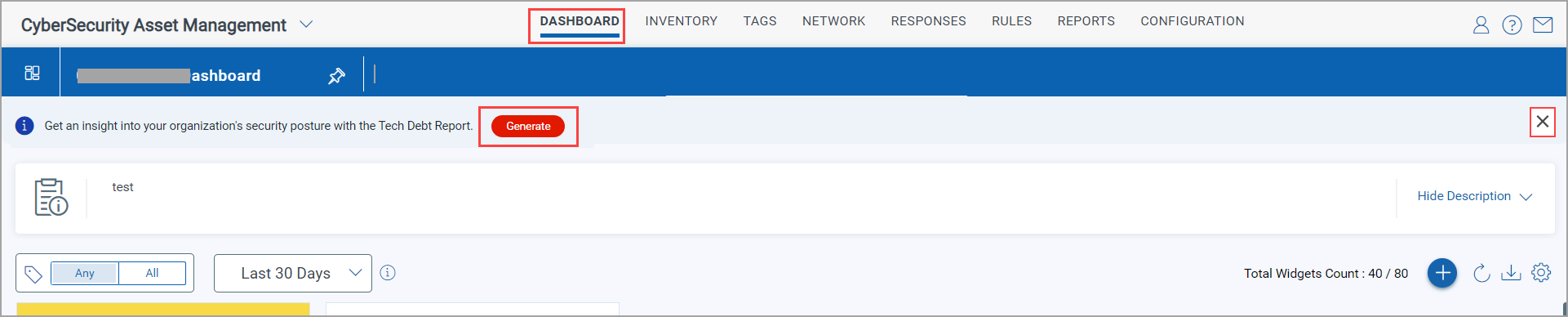
- After you click Generate to initiate the 'Technology Debt' report request from the Dashboard tab once, the Generate option is no longer available for the 'Technology Debt' report.
- You can close the banner if you do not want to generate the report immediately. After you close it, the banner is displayed again after 30 days. However, it is displayed again if Qualys introduces a new report within 30 days. If you select the Don't show again checkbox, the banner is displayed only when a new report is introduced.
- If you close the banner, you can still generate the report from the Notifications menu.
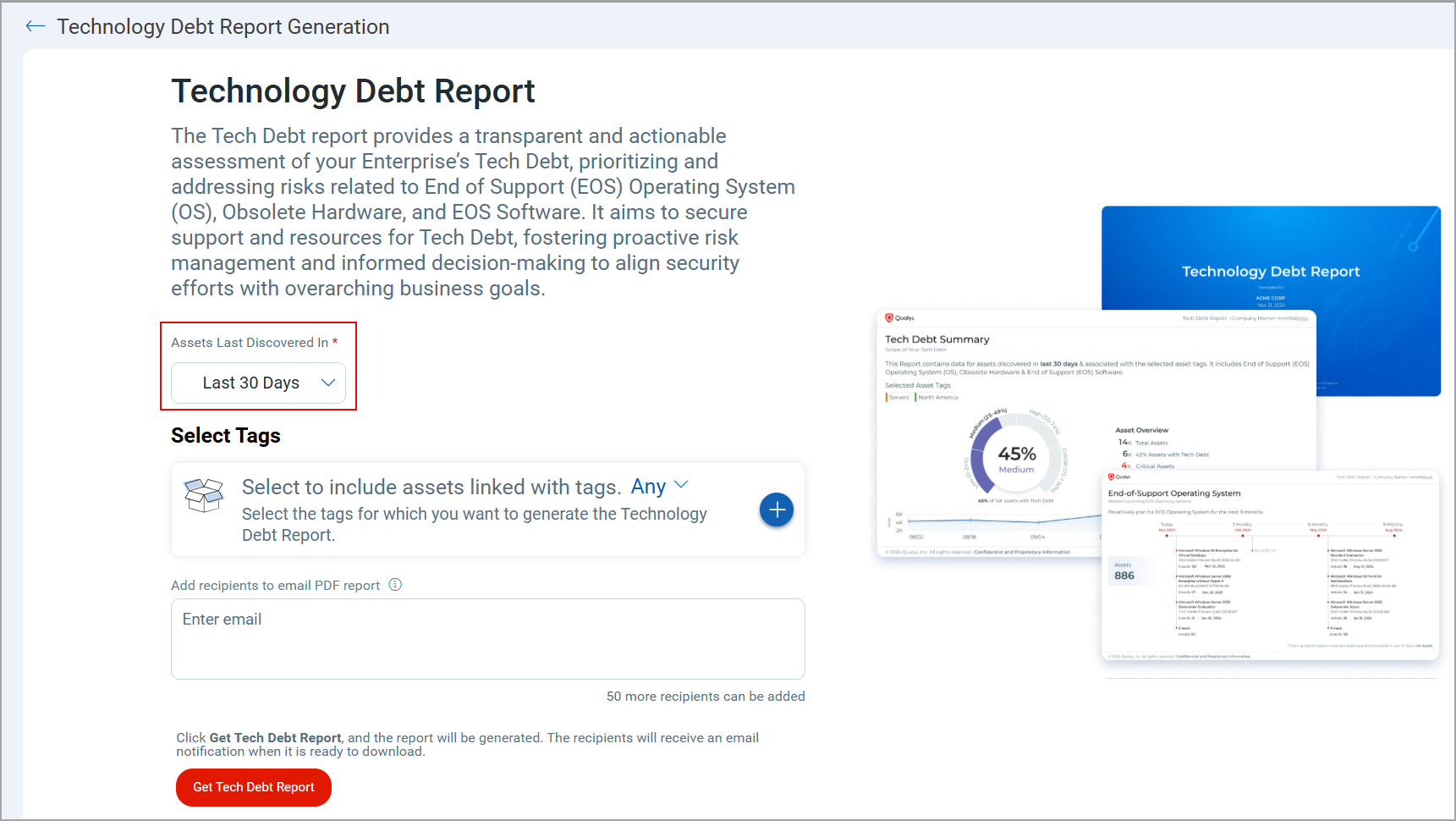
- Provide the following details on the Technology Debt Report page:
Field
Description
Assets Last Discovered In
Select the required time duration, such as Today, Last 24 Hours, and Last 7 days. You can also provide a specific time range.
It enables you to customize your Technology Debt report according to the time filter you provide.
Note: These selections are made as per the UTC time zone, and the time zone can't be changed.
Add recipients to email PDF reports
After the Tech Debt report is ready, by default, the notification is sent to the requester's email ID and the registered email ID for the subscription.
However, if you also want the email notification to be sent to other recipients, enter a comma-separated list of the intended recipients' email IDs to whom you want the email notification to be sent.
Create a Technology Debt Report
You can create a Technology Debt Report from the Reports tab.
Navigate to Reports > Create Report > Technology Debt Report. Complete each step and click Next to proceed.
Step 1: Basic Details
Provide a report title and description for the report.
|
Field |
Description |
|---|---|
|
Report Title |
Enter a title for the report. |
|
Report Description |
Enter a description for the report. |
Click Next.
Step 2: Report Source
Specify the assets or asset tags to include in your report.
|
Field |
Description |
|---|---|
|
Include hosts for the tags |
Select the tag matching criteria from the dropdown:
Click Create Tag to add tags for filtering the assets to include in the report. |
|
Exclude tags |
(Optional) Select this checkbox to exclude specific tags from the report. When enabled, you can select tags whose associated assets are excluded from the report. |
|
Assets Last Discovered In |
Select the required time duration to filter assets based on their last discovery time. For example, Last 30 Days. It enables you to customize your report to include only assets discovered within the specified time range. |
Click Next.
Step 3: Report Display
Configure notification settings for the report. Set up notifications to be triggered on execution of this report.
|
Field |
Description |
|---|---|
|
Actions |
Select Send Email (Via Qualys) from the Actions dropdown to configure email notifications. When selected, complete the following:
|
The email notification is sent after the report is generated for reports with Completed, Failed, or Incomplete statuses.
Click Next.
Step 4: Report Schedule
Configure the scheduling for your report. You can choose one of the following options:
- On Demand: The report runs once it is created.
- Schedule: Schedule the report to run at a specified time. When you select Schedule, provide the following details:
|
Field |
Description |
|---|---|
|
Start Date |
Select the date on which the report generation should start. |
|
Start Time |
Select the time at which the report generation should start. |
|
Recurring |
(Optional) Select this checkbox to create a recurring schedule. When enabled, configure the following:
|
You can manage schedules (view info, delete, and pause/resume schedule) from the Reports > Schedules tab.
Click Next.
Step 5: Review and Confirm
Review your selections across all steps. The summary displays the following sections:
- Basic Details: Shows the report name and description.
- Report Source: Shows the selected asset tags and time filter.
- Report Display: Shows the notification settings.
- Report Schedule: Shows the schedule type (On Demand or Scheduled).
You can edit any section by clicking the edit icon next to the section heading. This takes you back to the respective step to make changes.
Click Finish to create the report.
Download the Technology Debt Report
Users who generate a report can download it multiple times. When the report is ready, you receive an email notification.

You can download the report in the following methods:
- Clicking the download link in the email.
- Clicking Download Report from the Notifications menu in the CSAM UI.
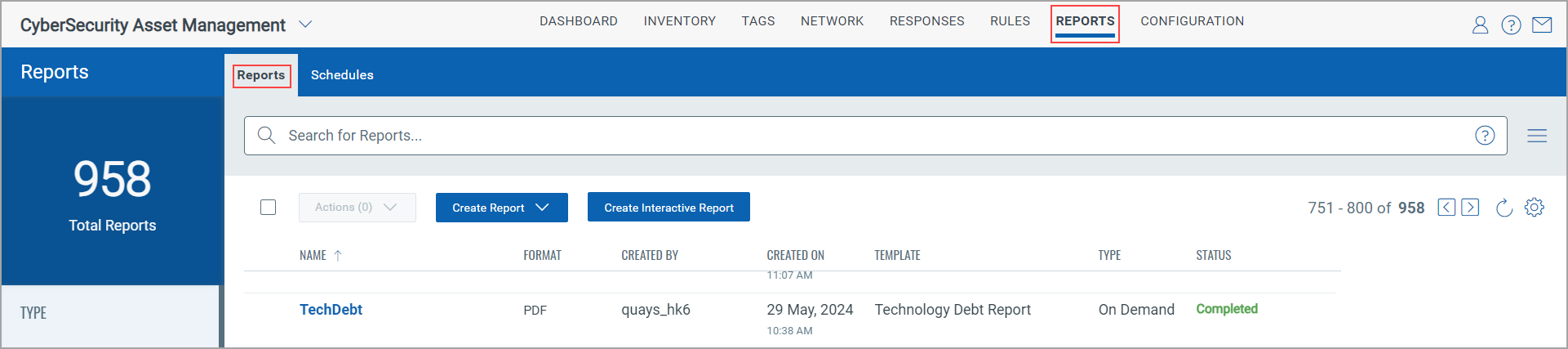
- From the Reports tab.
The Download Report notification is displayed under the Notification menu only for the next 15 days from the day the report generation request is initiated. After that, you can download the report from the Reports tab.
Trending Widget
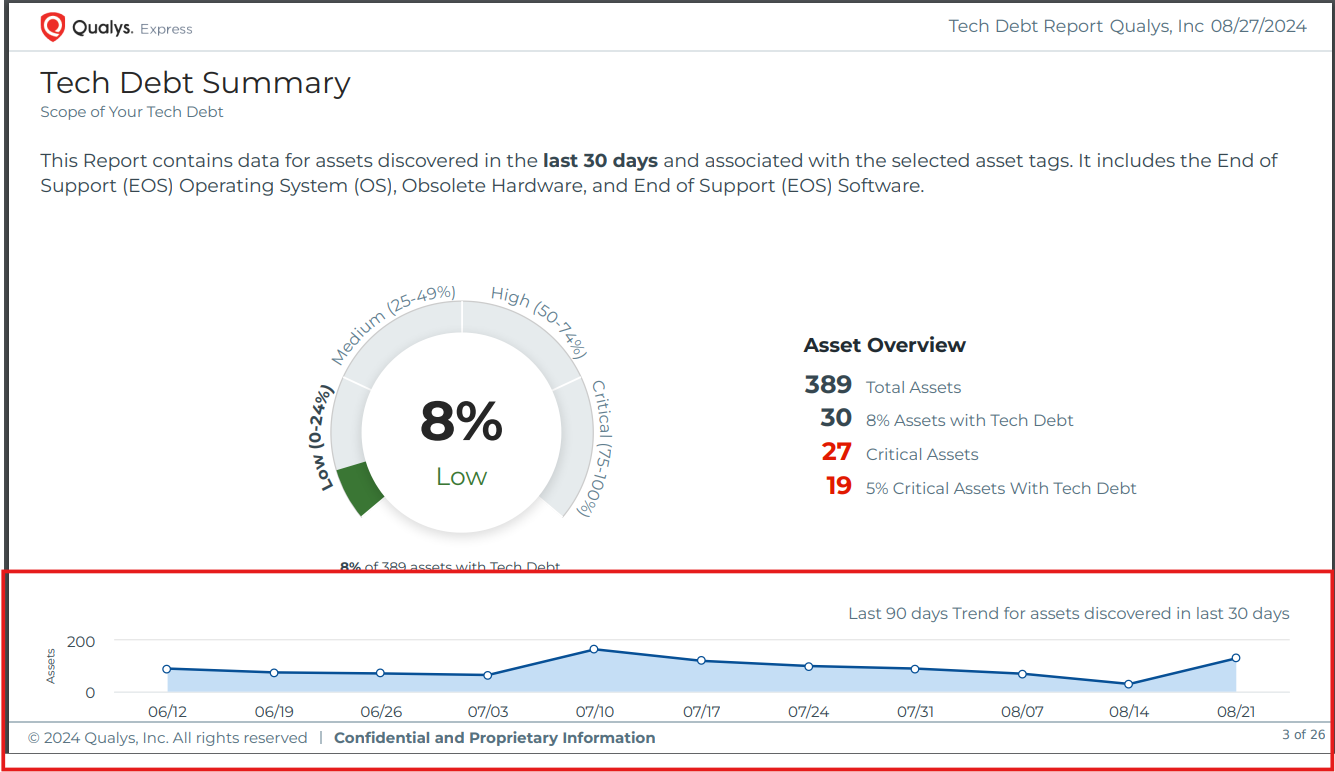
The Technology Debt report PDF includes a trending widget for assets discovered in the last 30 days. It shows precalculated data for the last 90 days trend for assets discovered over the last 30 days and associated with the selected asset tags.
Important: You cannot see the trending widget on the report immediately after you generate it, as the trending counts are collected according to the weekly pre-set schedule, and the weekly scheduled job might not have been triggered for execution. Also, fewer points between 1 and 13 can be seen on the trending widget.