What is Enterprise TruRisk Management
Enterprise TruRisk Management (ETM) is Qualys's comprehensive platform for managing cybersecurity risk across your entire hybrid environment. It consolidates vulnerability data, asset intelligence, and threat context into a unified risk management system designed to help you prioritize remediation and reduce organizational risk.
Risk Operations Center with Enterprise TruRisk Management
The Risk Operations Center (ROC) is a unified, operational framework designed to continuously measure, prioritize, and reduce cyber risk. ETM (Enterprise TruRisk Management) serves as the technology foundation behind ROC—providing the intelligence, scoring, and data unification that transforms security data into business-aligned, actionable insights.
Why Organizations Need a ROC
With rapidly expanding attack surfaces and an overload of alerts from separate security tools, it is increasingly difficult for teams to understand which risks truly matter. While Security Operations Centers (SOC) focus on incident detection and response, organizations also need an operational function dedicated to proactive risk reduction.
The ROC addresses this need by enabling teams to:
- Continuously quantify and monitor cyber risk
- Prioritize actions based on real business impact
- Connect security signals to financial and operational outcomes
- Drive coordinated, cross-team reduction of risk
How the ROC Works
The ROC operationalizes cyber risk from detection to action using a continuous, closed-loop workflow. This workflow is powered by ETM, which aggregates and standardizes all relevant risk data and applies the TruRisk™ scoring and quantification model.

By combining people, processes, and technology, the ROC provides a business-aligned approach to risk measurement and reduction—turning cybersecurity from a technical function into a strategic enabler.
What is Enterprise TruRisk Management (ETM)?
ETM is the industry’s first cloud-based ROC platform and the intelligence engine behind the ROC. It centralizes and unifies risk data across Qualys applications (VMDR, CSAM, Policy Audit, WAS) and third-party tools, giving organizations full visibility of their digital footprint.
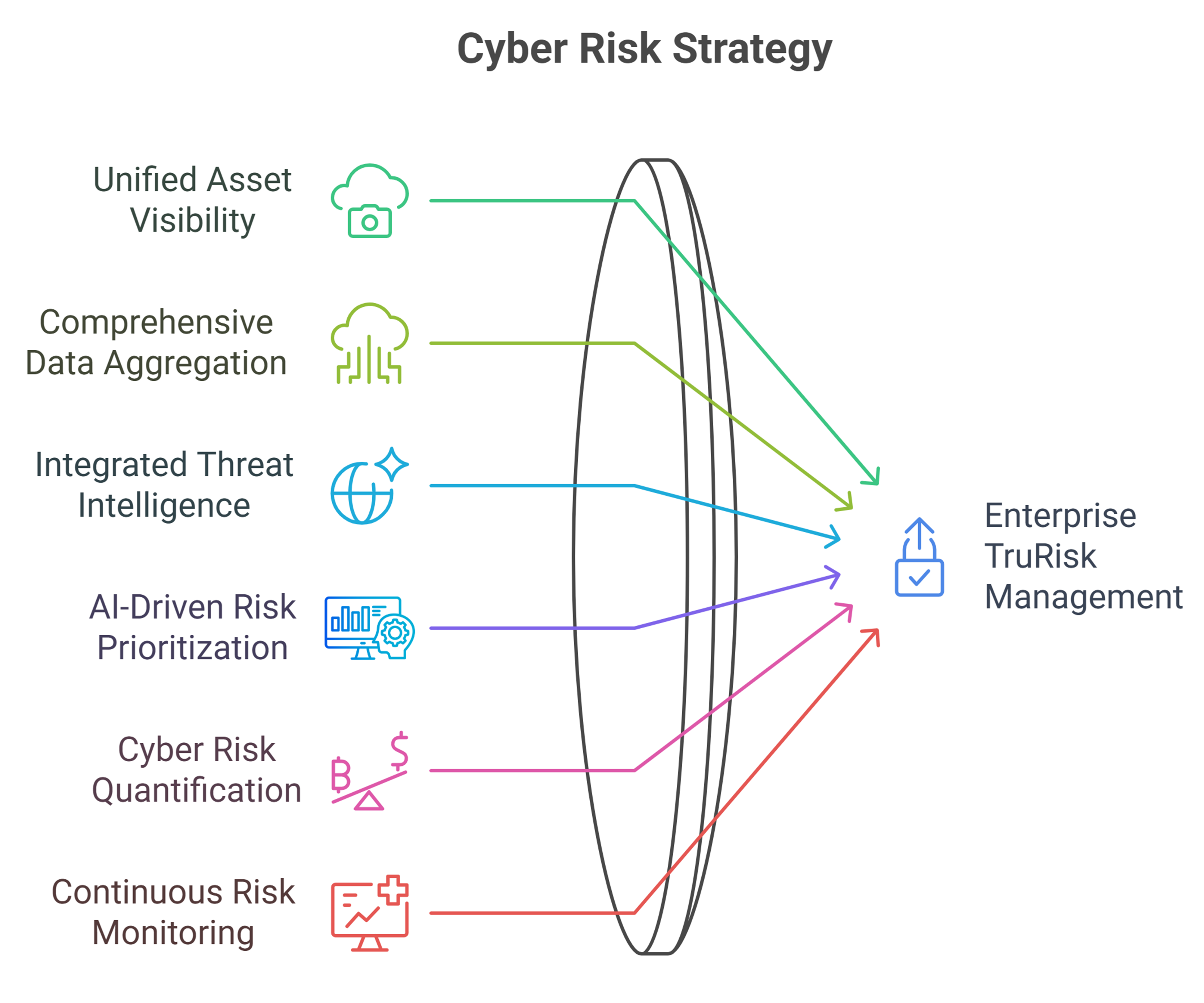
Key Capabilities of ETM
- Unified Asset and Risk Visibility: Consolidates all risk and asset data into one consistent view.
- Comprehensive Data Aggregation: Ingests data from Qualys sensors, cloud connectors, and third-party tools.
- Integrated Threat Intelligence: Enhances findings with insights from 25+ threat feeds.
- AI-Driven Prioritization: Identifies and ranks the most exploitable and business-critical risks.
- Cyber Risk Quantification: Converts technical findings into financial impact.
- Continuous Risk Monitoring: Updates TruRisk™ Scores based on new findings and remediation activity.
Role of ETM in the ROC Framework
ETM functions as the analytical and operational backbone of the ROC, providing standardized risk scoring, quantification, and prioritization. It transforms fragmented risk signals into actionable insights for decision-making.
| Function | Role of ETM in ROC |
|---|---|
| Data Aggregation | Unifies all risk and asset data from Qualys and external sources. |
| Normalization | Standardizes findings (for example, CVEs, IDs) for consistent scoring and correlation. |
| TruRisk™ Scoring | Applies the Qualys Detection Score and Asset Criticality to calculate accurate TruRisk™ Scores. |
| Risk Quantification | Translates technical vulnerabilities into business and financial metrics. |
| Prioritization and Orchestration | Guides remediation based on risk appetite, business entity hierarchy, and impact thresholds. |
| Collaboration Enablement | Provides shared visibility across security, IT, and business teams. |
Business Impact
By integrating ETM with the ROC, organizations move from reacting to cyber threats to proactively reducing measurable business risk. This unified approach transforms cybersecurity from a cost center into a strategic driver of resilience and business value.
Watch this video for a quick overview of the ETM application.